


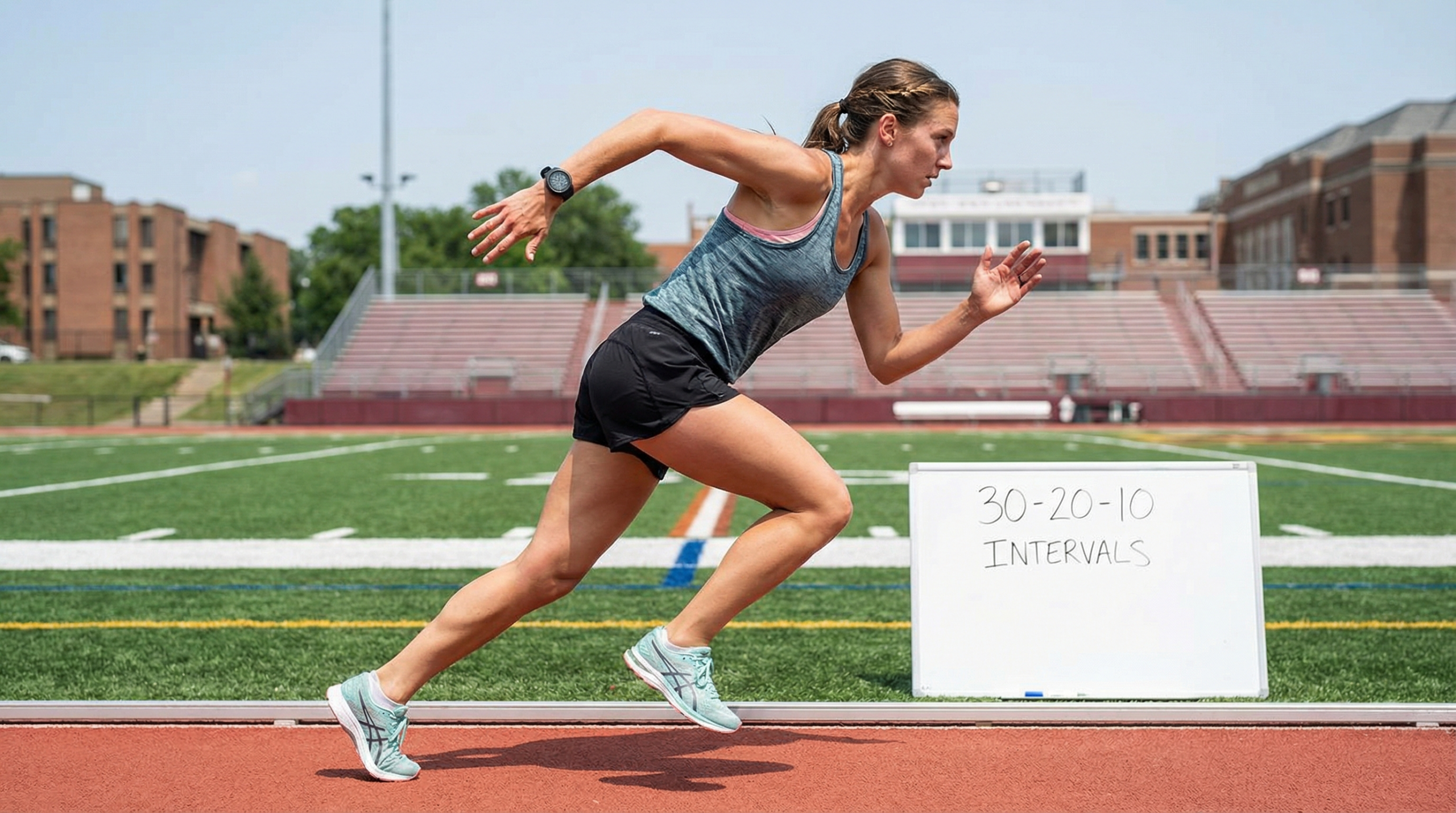
The 30-20-10 workout is an interval training method where you exercise for 30 seconds at low intensity, 20 seconds at medium intensity, and 10 seconds at maximum effort, then repeat. With a 467% increase in search interest in 2025, this Danish-developed training protocol has gained massive popularity for its efficiency and proven results. Studies show the 30-20-10 workout improves fitness faster than traditional cardio while cutting your workout time in half.
What Is the 30-20-10 Workout?
The 30-20-10 workout was developed by researchers at the University of Copenhagen in Denmark. The protocol reverses traditional interval training by starting slow and finishing fast within each 60-second block.
Here’s how one interval works:
- 30 seconds: Low intensity (easy pace, about 30% effort)
- 20 seconds: Medium intensity (moderate pace, about 60% effort)
- 10 seconds: High intensity (all-out sprint, 90-100% effort)
You repeat this 60-second cycle 5 times to complete one block (5 minutes). A typical session includes 3-4 blocks with 2 minutes rest between blocks, totaling just 20-30 minutes including warm-up and cool-down.
If you’re new to fitness, the 30-20-10 workout pairs perfectly with setting realistic fitness goals since it’s adaptable to any starting level.
The Science Behind 30-20-10 Training
The original Copenhagen study published in the Journal of Applied Physiology tested the 30-20-10 protocol on recreational runners. The results were remarkable:
- 5K running time improved by an average of 38 seconds
- 1500m time improved by 23 seconds
- VO2 max (cardiovascular fitness) increased significantly
- Blood pressure and cholesterol levels decreased
- Training volume was reduced by 50% compared to their previous routines
The researchers found that the brief 10-second sprints created powerful metabolic and cardiovascular adaptations, while the 30-second recovery periods allowed sustainable repetition without burnout.
According to American Council on Exercise, interval training creates an “afterburn effect” (excess post-exercise oxygen consumption) that continues burning calories for hours after your workout ends.
Benefits of the 30-20-10 Workout
1. Saves Time Without Sacrificing Results
A complete 30-20-10 workout takes only 20-30 minutes including warm-up. The Copenhagen study showed participants achieved better results in half the training time compared to traditional steady-state cardio.
2. Improves Cardiovascular Fitness Faster
The combination of intensities challenges your heart and lungs more effectively than single-pace exercise. VO2 max improvements happen rapidly, often within 7-8 weeks of consistent training.
3. Burns More Calories
High-intensity intervals boost your metabolic rate during and after exercise. Studies suggest interval training burns 25-30% more calories than steady cardio of equal duration.
4. Reduces Blood Pressure
The original research showed significant reductions in both systolic and diastolic blood pressure among participants. This makes the 30-20-10 workout valuable for heart health beyond just fitness.
5. Lowers Cholesterol
Participants in the Copenhagen study experienced improved cholesterol profiles, with reductions in LDL (bad cholesterol) and increases in HDL (good cholesterol).
6. Beginner-Friendly Design
Unlike traditional HIIT that starts with high intensity, the 30-20-10 workout eases you in with 30 seconds of easy movement. This makes each interval psychologically manageable and reduces injury risk.
7. Prevents Boredom
Constantly changing intensities keeps your mind engaged. Many people who find steady cardio monotonous enjoy the variety and mental challenge of the 30-20-10 structure.
Need help managing post-workout soreness? Check our 7 tips to reduce soreness after exercise.
How to Do the 30-20-10 Workout: Step-by-Step
Step 1: Warm Up (5 Minutes)
Never skip the warm-up before high-intensity work. Start with:
- 2-3 minutes of easy walking or light jogging
- Dynamic stretches: leg swings, arm circles, hip rotations
- Gradually increase pace to prepare your cardiovascular system
Step 2: Complete Your First Block (5 Minutes)
Perform the 30-20-10 sequence 5 times back-to-back:
Interval 1:
- 30 seconds: Jog at easy, conversational pace
- 20 seconds: Run at moderate effort (breathing harder)
- 10 seconds: Sprint at maximum effort (all-out)
Immediately repeat 4 more times without stopping.
After completing 5 intervals, you’ve finished one 5-minute block.
Step 3: Rest Between Blocks (2 Minutes)
Walk slowly or stand still for 2 minutes. Focus on controlling your breathing and letting your heart rate recover. Stay moving gently rather than sitting down.
Step 4: Complete Additional Blocks
Beginners start with 2-3 blocks. As fitness improves, progress to 4 blocks. Each block includes 5 repetitions of the 30-20-10 sequence.
| Fitness Level | Blocks | Total Interval Time |
|---|---|---|
| Beginner | 2 blocks | 10 minutes |
| Intermediate | 3 blocks | 15 minutes |
| Advanced | 4 blocks | 20 minutes |
Step 5: Cool Down (5 Minutes)
After your final block, don’t stop abruptly. Walk at an easy pace for 3-5 minutes, then perform static stretches for your legs, hips, and lower back.
30-20-10 Workout for Different Activities
While running is the most common application, the 30-20-10 workout works with many exercises:
Running (Outdoor or Treadmill)
- 30 seconds: Easy jog (5.0-6.0 mph)
- 20 seconds: Moderate run (7.0-8.0 mph)
- 10 seconds: Sprint (9.0+ mph or maximum)
Cycling (Outdoor or Stationary)
- 30 seconds: Easy pedaling (low resistance)
- 20 seconds: Moderate effort (medium resistance)
- 10 seconds: All-out sprint (high resistance, fast cadence)
Swimming
- 30 seconds: Easy breaststroke or backstroke
- 20 seconds: Moderate freestyle
- 10 seconds: Sprint freestyle
Rowing Machine
- 30 seconds: Easy rowing (18-20 strokes/min)
- 20 seconds: Moderate rowing (22-24 strokes/min)
- 10 seconds: Maximum effort (26+ strokes/min)
Elliptical
- 30 seconds: Easy pace (low resistance)
- 20 seconds: Moderate effort (medium resistance)
- 10 seconds: All-out effort (high resistance, fast strides)
Jump Rope
- 30 seconds: Easy single jumps
- 20 seconds: Faster single jumps
- 10 seconds: Double unders or high knees
New to gym equipment? Read what to bring to the gym for your first time.
4-Week 30-20-10 Beginner Program
| Week | Sessions | Blocks per Session | Total Workout Time |
|---|---|---|---|
| Week 1 | 2 sessions | 2 blocks | ~20 minutes |
| Week 2 | 3 sessions | 2 blocks | ~20 minutes |
| Week 3 | 3 sessions | 3 blocks | ~25 minutes |
| Week 4 | 3 sessions | 3-4 blocks | ~30 minutes |
Important: Allow at least one rest day between 30-20-10 sessions. The high-intensity bursts require recovery time.
30-20-10 vs. Traditional HIIT
| Aspect | 30-20-10 Workout | Traditional HIIT |
|---|---|---|
| Structure | 30 slow → 20 medium → 10 fast | Usually 20-30 sec hard, then rest |
| Sprint duration | Only 10 seconds | Often 20-30 seconds |
| Recovery within interval | Built-in (30 sec easy) | Separate rest periods |
| Psychological approach | Eases into intensity | Starts at high intensity |
| Beginner friendliness | Very accessible | Can feel overwhelming |
| Session duration | 20-30 minutes total | 20-45 minutes total |
| Research backing | Specific peer-reviewed studies | General HIIT research |
The key advantage of the 30-20-10 workout is psychological: knowing you only need to sprint for 10 seconds makes the high-intensity portion feel achievable, even when you’re tired.
Tips for Better 30-20-10 Results
1. Use a Timer App
Download an interval timer app like Seconds, Tabata Timer, or Interval Timer. Set custom intervals for 30-20-10 so you can focus on exercise instead of watching the clock.
2. Actually Sprint During the 10 Seconds
The magic happens in those 10-second bursts. Don’t hold back—give genuine maximum effort. It’s only 10 seconds, and you immediately get recovery time.
3. Keep Moving During the 30-Second Phase
The 30-second portion is active recovery, not complete rest. Maintain easy movement to keep blood flowing and prepare for the next intensity increase.
4. Progress Gradually
Start with 2 blocks and add one block every 1-2 weeks. Rushing progression increases injury risk and can lead to burnout.
5. Choose Appropriate Surfaces
When running outdoors, choose flat, even surfaces for sprints. Trails with roots or uneven pavement increase injury risk during all-out efforts.
6. Fuel Properly
Eat a light snack 1-2 hours before your workout. The high-intensity nature requires available energy. Post-workout, prioritize protein and carbs for recovery.
Learn how to listen to your body during workouts for optimal performance.
Common 30-20-10 Workout Mistakes
- Going too hard during the 30-second phase: This should feel genuinely easy—save energy for the sprint
- Not sprinting hard enough during 10 seconds: Maximum effort is required for full benefits
- Skipping the warm-up: Cold muscles plus sprinting equals injury risk
- Doing too many blocks too soon: Start with 2 blocks, even if you feel capable of more
- Training every day: High-intensity work requires 48 hours recovery minimum
- Using poor form when tired: Maintain technique even during final sprints
- Ignoring rest between blocks: The 2-minute rest is essential, not optional
- Expecting instant results: Give the program 6-8 weeks for significant improvements
Who Should Try the 30-20-10 Workout?
This protocol benefits a wide range of people:
- Busy professionals: Maximum results in minimum time
- Runners wanting to improve pace: Proven to reduce 5K and 1500m times
- Cardio beginners: Approachable structure that builds gradually
- People bored with steady cardio: Engaging format that keeps you focused
- Those with high blood pressure: Research shows cardiovascular benefits
- Weight loss seekers: Higher calorie burn than traditional cardio
- Athletes in any sport: Builds speed and cardiovascular capacity
Caution: If you have heart conditions, joint problems, or are completely new to exercise, consult a doctor before starting high-intensity training. Consider building a base with walking or easy jogging first.
Thinking about joining a gym? Read what to consider when choosing a gym.
Sample Weekly Schedule
Here’s how to incorporate the 30-20-10 workout into a balanced fitness routine:
| Day | Workout |
|---|---|
| Monday | 30-20-10 running (3 blocks) |
| Tuesday | Strength training or yoga |
| Wednesday | Rest or light walking |
| Thursday | 30-20-10 cycling (3 blocks) |
| Friday | Strength training |
| Saturday | 30-20-10 running (3-4 blocks) |
| Sunday | Complete rest |
This schedule provides 3 interval sessions while allowing adequate recovery and incorporating other training modalities.
How to Progress Your 30-20-10 Training
Once you’ve mastered the basic protocol, increase the challenge:
- Add more blocks: Progress from 3 to 4 to 5 blocks
- Increase sprint speed: Push harder during 10-second phases
- Reduce rest between blocks: Drop from 2 minutes to 90 seconds
- Add incline: Run hills or increase treadmill incline
- Try different activities: Apply the protocol to swimming, rowing, or cycling
- Increase frequency: Add a fourth weekly session when adapted
Frequently Asked Questions
How many times per week should I do 30-20-10?
Start with 2 sessions per week, progressing to 3 sessions as fitness improves. Always allow at least one rest day between sessions. More than 4 sessions weekly is not recommended due to the high-intensity nature.
Can I do 30-20-10 on a treadmill?
Yes, treadmills work well for this workout. The only challenge is adjusting speed quickly between phases. Some people prefer manually increasing/decreasing speed, while others jump onto the side rails briefly during transitions.
Is 30-20-10 better than running at a steady pace?
Research suggests 30-20-10 produces superior cardiovascular improvements and performance gains compared to equal-time steady-state running. However, both have value—easy runs build aerobic base while intervals build speed and efficiency.
Can beginners do this workout?
Yes, with modifications. Complete beginners should start with just 2 blocks and adjust intensities to their current fitness level. Your “sprint” doesn’t need to match an athlete’s—it just needs to be YOUR maximum effort.
How long until I see results?
The Copenhagen study showed significant improvements within 7 weeks. Most people notice better endurance and energy within 3-4 weeks. Measurable performance improvements (like faster running times) typically appear by week 6-8.
What if I can’t sprint for the full 10 seconds?
Start where you are. Even 5-7 seconds of high intensity with 3-5 seconds at moderate pace still provides benefits. Gradually extend your sprint duration as fitness improves over weeks.
Can I use this for weight loss?
Yes, the 30-20-10 workout burns more calories than steady cardio and creates an afterburn effect. Combined with proper nutrition, it’s an effective tool for fat loss while preserving muscle mass.
The Bottom Line
The 30-20-10 workout delivers science-backed results in minimal time. By structuring intervals from low to high intensity, this Danish protocol makes high-intensity training psychologically manageable while producing superior fitness improvements.
The research is compelling: faster running times, improved cardiovascular fitness, reduced blood pressure, and better cholesterol—all achieved in half the training time of traditional cardio. For busy people seeking efficient, effective exercise, the 30-20-10 workout is an evidence-based solution.
Start with two sessions per week, two blocks per session. Use a timer app, warm up properly, and give genuine maximum effort during those 10-second sprints. Within 6-8 weeks, you’ll likely notice significant improvements in both fitness and performance.
The beauty of the 30-20-10 workout lies in its simplicity: 30 seconds easy, 20 seconds moderate, 10 seconds all-out. Repeat, rest, and watch your fitness transform.
Ready to build a complete fitness routine? Learn about setting realistic fitness goals to complement your interval training.
